
Established in 1885 to honor President George Washington, Presidents’ Day gained worldwide popularity after becoming part of the 1971 Uniform Monday Holiday Act, an attempt to give American workers more 3-day weekends. Presidents’ Day is now seen as a time to celebrate all US presidents, both past and present.
Since we love science, we wanted to highlight some leaders who loved science, too.
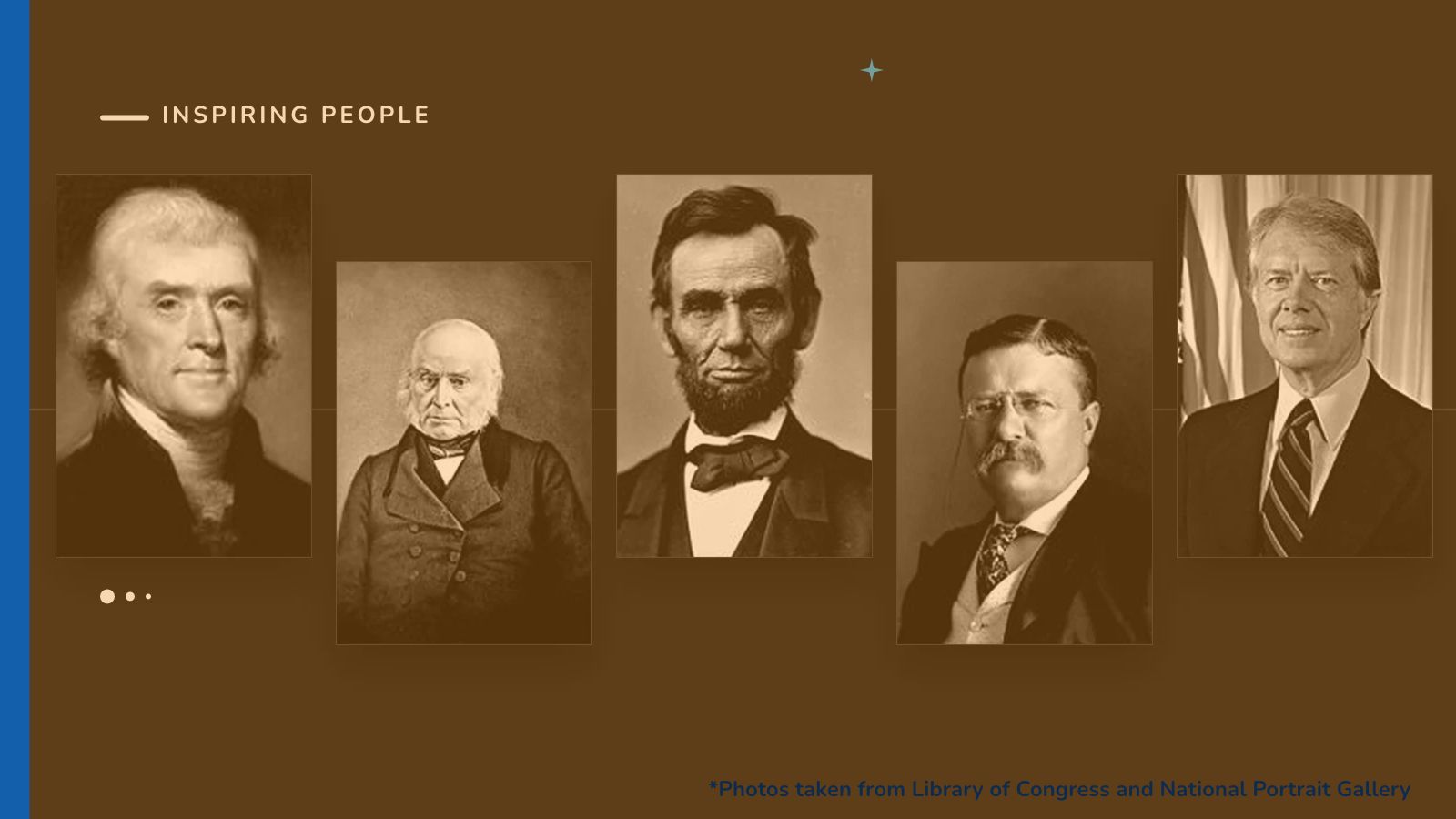
Thomas Jefferson loved science, engineering, architecture, and philosophy. He designed a clock powered by cannonball-shaped weights that slowly fall under the pull of gravity. It shows the day of the week as well as the hour, and he even cut a hole in the floor so the weights had room to drop! He also designed his own home, Monticello, launched a survey of the nation’s coasts, and sponsored the Lewis and Clark Expedition to explore the American West.
Abraham Lincoln signed the law creating the National Academy of Sciences. He was determined to modernize American farming, signing the law that created the Department of Agriculture and helping farmers learn new methods, machinery, and ideas to improve their land. He even held a patent for a way to lift boats over sandbars and shoals.
Theodore Roosevelt is remembered for his efforts to preserve nature. He argued that we must use our natural resources responsibly instead of wasting them or depriving future generations. An enthusiastic learner with an interest in geography and biology, he protected about 150 million acres of national forest for public use. He also created the U.S. Forest Service in 1905. After leaving office, he joined the Roosevelt-Rondon Scientific Expedition, which explored the River of Doubt, a tributary of the Amazon in Brazil.
- Harry Truman signed the 1950 law that created the National Science Foundation, which still funds scientific research across the country.
- Dwight Eisenhower formed a panel of science advisers after the Soviet Union launched the Sputnik satellite in 1957. The panel’s advice led him to ask Congress to create a civilian space agency, and in 1958 he signed the law that created NASA.
- John F. Kennedy challenged the country to land a person on the Moon. In 1961, he asked Congress to commit to that goal before the end of the decade. He did not live to see it, but astronauts landed on the Moon in 1969.
- Jimmy Carter earned a bachelor of science degree from the U.S. Naval Academy and worked on the Navy’s early nuclear propulsion program. He kept the Space Shuttle program going and backed the Hubble Space Telescope. He also started the U.S. Department of Energy and encouraged people to save energy and explore alternative energy sources.
If your would like to get involved