Background
Science is for Me! is an innovative program to increase interest in science and feeling of belonging in science among young children, especially those from historically marginalized communities. It addresses several issues, including a lack of high-quality science education in its target communities, and the lack of diversity in representation in STEM fields. It has seen remarkable growth due to demand and has potential for significant impact in the San Francisco Bay Area and beyond. The program is anchored by a series of 23 books (with more in development) featuring children of color who solve everyday problems using science, coupled with step-by-step illustrations for science experiments that enable young children to complete activities on their own. Family engagement, a key component, is provided via an adult companion in three languages (English, Spanish, Chinese) so families can talk about science in their home language. Books are distributed together with all materials needed to do the experiments, to make this resource accessible.
This program is the brainchild of Science is Elementary (SiE), a 501c3 nonprofit with a mission to provide inspiring, innovative, high-quality science experiences to the preschool and elementary school children who need them most, and a 15-year track record of closing gaps in science interest and achievement for low-income students of color. Since its inception, SiE has focused its work on low-income communities of color, valuing diversity, inclusion, and belonging. Almost 80% of its students come from low-income families and 75% are people of color.
Executive Summary
An evaluation of the Science is for Me! program was conducted in the summer of 2023 by external evaluators, and consisted of in-depth observations using protocols developed by field experts, as well as pre- and post- surveys of children, educators, and families. Each session lasted about 45 minutes. In total, observations included 73 families, 300 children, and 40 educators in two settings:
- Libraries: to evaluate how adult caregivers and children interact with the books and materials when not directly instructed.
- Out-of-school time: to evaluate how groups of children interact with Science is for Me! materials, when led by adults who are neither teachers nor have significant pedagogical training. These sessions were hosted by several community based organizations that Science is Elementary partners with.
The evaluation suggests that just one session of Science is for Me! is meaningfully effective in improving children’s attitudes to science as well as their self-reported confidence in science. The effect is stronger for girls than boys. We also found that the program is effective in improving self-reported confidence in science for both adult caregivers and educators who participated in the Science is for Me! program.
Methodology
Pre- and post surveys utilized items selected from the Puppet Interview Scales of Competence in and Enjoyment of Science (PISCES) developed by Mantzicopoulos, Patrick, & Samarapungavan (2008). PISCES was developed to test young children’s motivational beliefs related to science learning. Given the time constraints for this Science is for Me! evaluation, three items with the highest factor loading on each factor (strongest correlation) were selected: science competence, science liking, and ease of learning science.
A Likert scale design was used, following the recommendations from Mellor & Moore (2013). This work suggests that asking children to express opinions using scales labeled with words (e.g. similarity-to-self) shows better agreement with binary answers.
The survey content can be viewed here.
The evaluation followed this written protocol. In the out-of-school setting, the observers walked around the classroom and chatted with students individually or in pairs, if students were sitting around a table together, for both pre- and post-survey. In the library setting, adult caregivers assisted their children in filling out the surveys before and after the activity.
Results
Children, overall
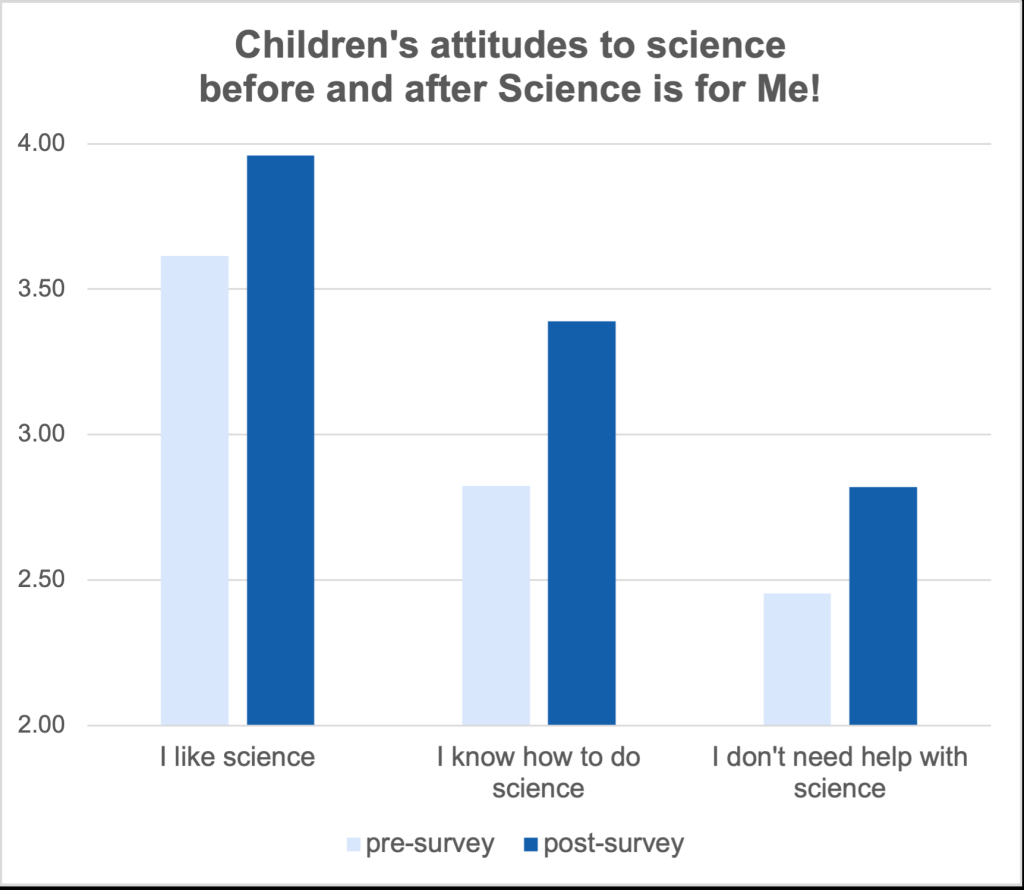
In both settings, children rated their science competence (“I can do science”), science liking (“I like science”), and ease of learning science (“I don’t need help with science”) more highly after they participated in the Science is for Me! program.
Children, gender differences
Research has shown a gender gap in motivation towards science. Patrick, Mantzicopoulos, & Samarapungavan (2009) found a gender gap in interest in science starting as early as in kindergarten and Baram-Tsabari & Yarden (2010) found that while boys and girls do not differ in their interests in science in early elementary, by the end of high school boys are 20 times more likely to be interested in STEM subjects than girls.
We found similar patterns in our data. Before participating in a Science is for Me! activity, boys reported higher scores in their ease of learning science (I don’t need help with science) and science competence (I know how to do science) than girls.
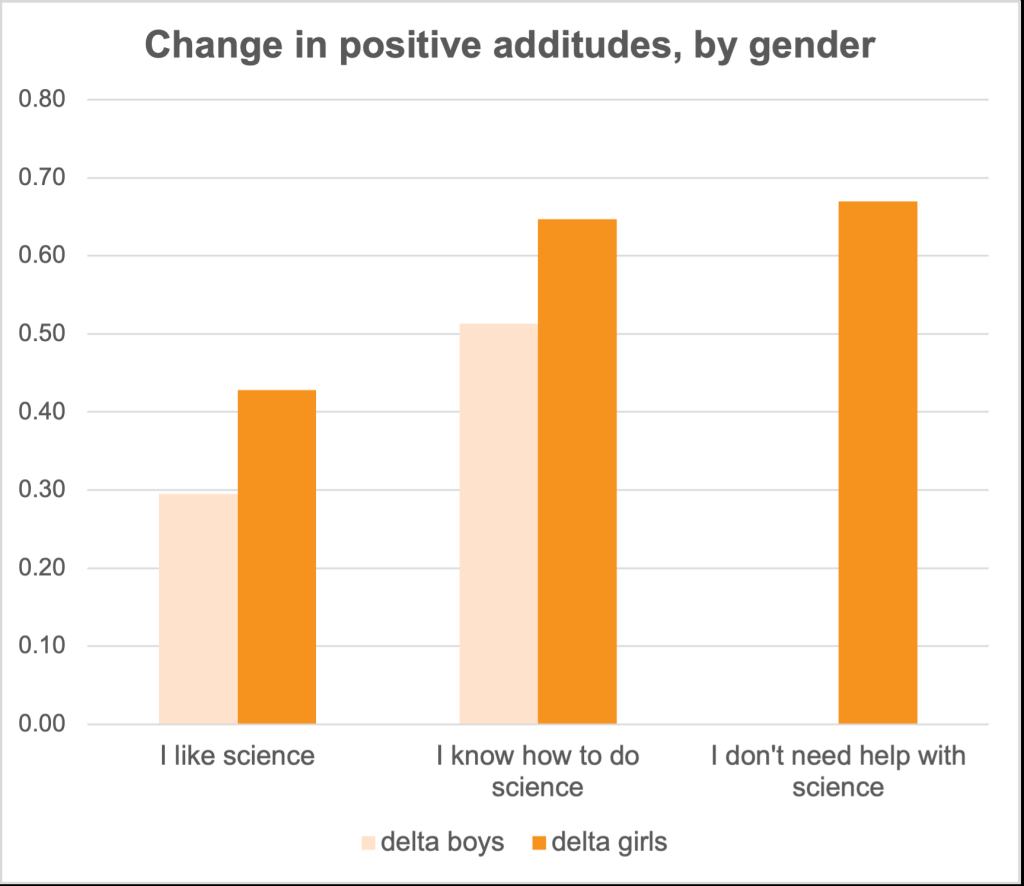
Both boys and girls participating in a Science is for Me! program showed increased positive attitudes to science and self-reported confidence in science.
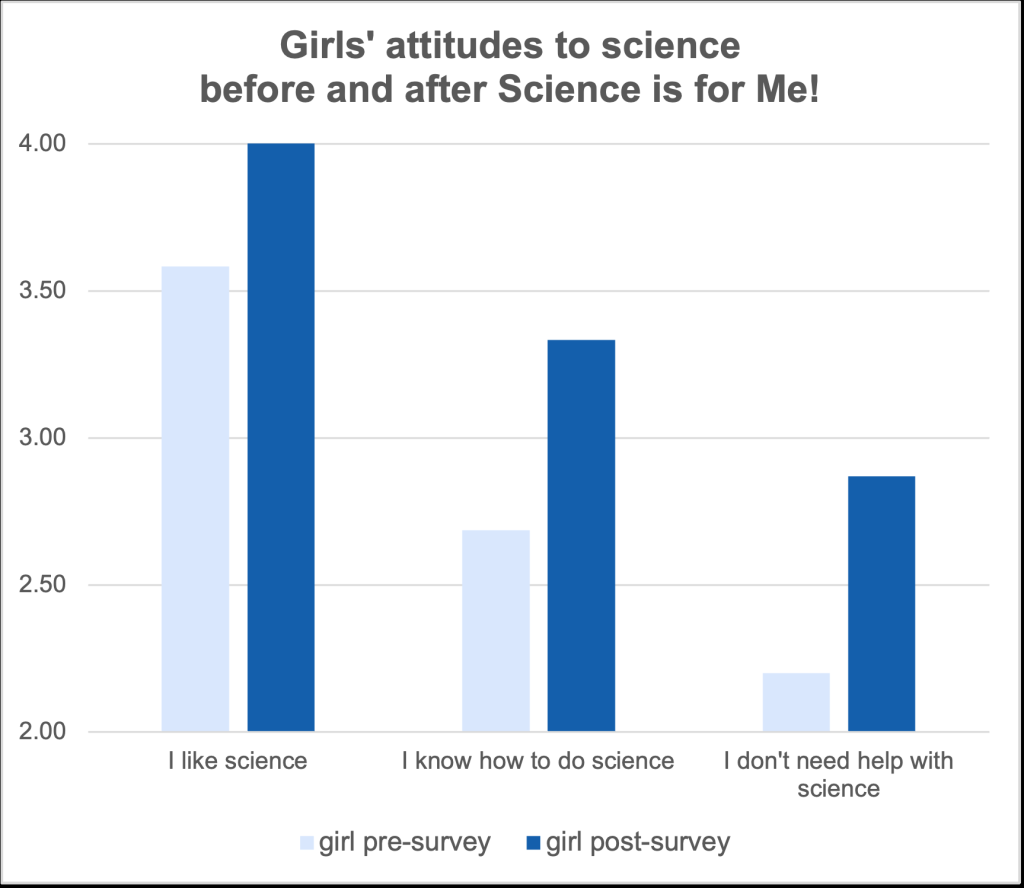
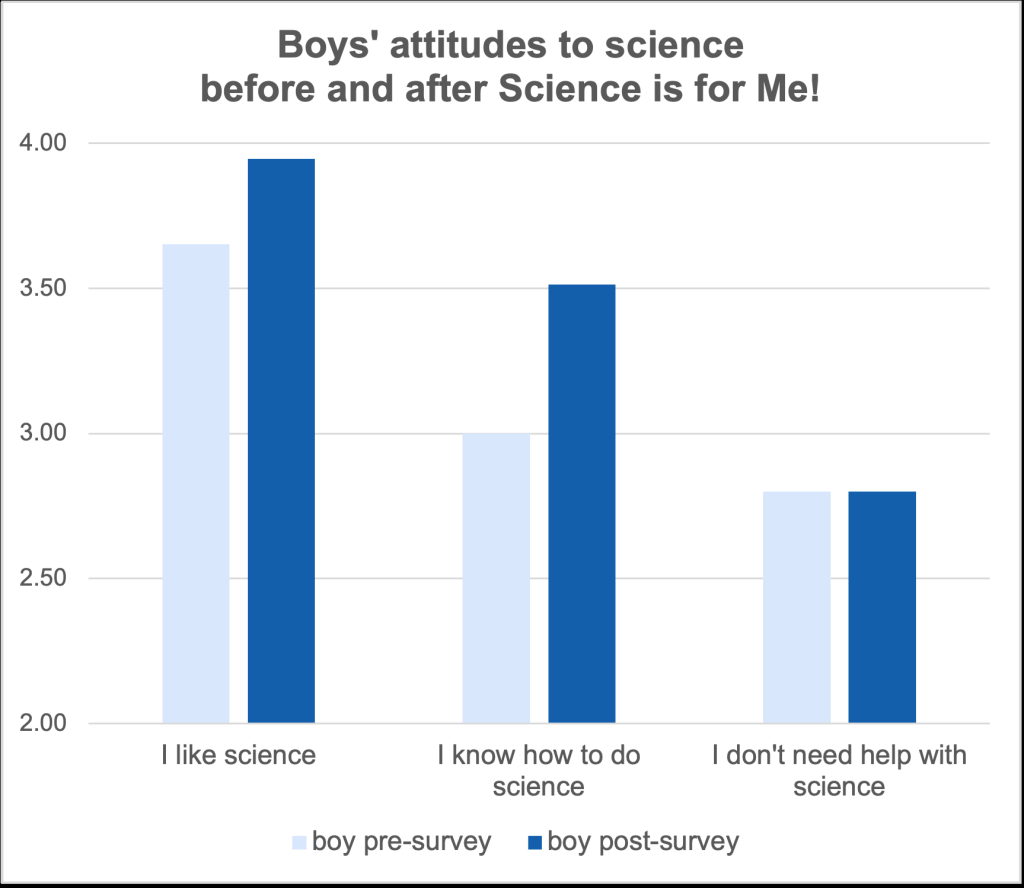
We also found that across the three factors, girls showed a larger increase in their ratings than boys, showing the program’s stronger impact on girls.
Adult caregivers
We asked caregivers about the biggest challenges they faced in incorporating science in their daily life with their children. The two most prevalent obstacles are materials and time: 56.2% reported that they do not have the right materials to do science at home and 49.3% reported that there is not enough time to explore science at home.
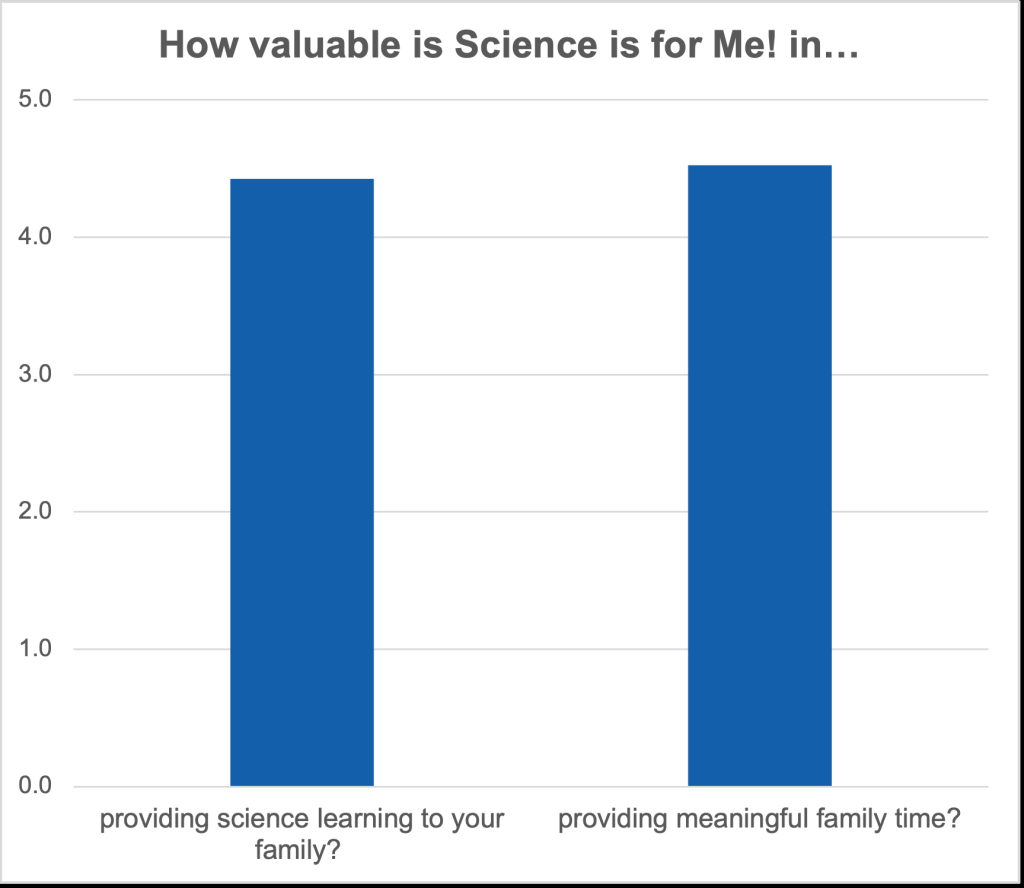
After participating in one Science is for Me! session, adults rated the program highly valuable for providing science learning opportunities (4.43 on a 5-point scale) and meaningful family time (4.52 on a 5-point scale).
Additionally, adults reported that they are more confident in doing science at home compared to before participating in the Science is for Me! session (4.39 post vs 3.99 pre, on a 5-point scale), and that they will incorporate science more frequently at home (3.80 post vs 3.33 pre, on a 5-point scale).
Educators
Educators are adults who facilitated sessions at a site run by one of Science is Elementary’s partner organizations. Their experiences with science education (and education in general) are highly variable. Unfortunately, due to time constraints and limited staffing at some partner sites, not all educators could complete the survey and so the small small sample size (13) is likely to make the quantitative results under-powered
The survey was similar to the one provided to adult caregivers.
The biggest challenge educators identified in incorporating science in their teaching is lack of the right materials for science (39%).
Educators reported that they are more confident in their science teaching after using a Science is for Me! book and kit to facilitate science activities with children (4.08 post vs 3.54 pre). They also reported that they will incorporate science more frequently in the classroom (3.77 post vs 3.17 pre).
Future work
This evaluation provides preliminary evidence that the Science is for Me! program is effective in improving children’s attitude towards science. In addition, we also found some evidence suggesting that the activity can help adult caregivers and educators gain confidence in facilitating scientific experiences and engaging in science conversations with children.
Future evaluations will include the following:
- Comparing the effectiveness of the program across different implementation formats and frequency. In the current evaluation, all children participated in one session led by a parent or a minimally trained educator. Building upon this foundation, the next phase of research will explore the potential benefits derived from multiple sessions facilitated by the same adults, as well as sessions expertly facilitated by highly trained science education professionals. The goal will be to uncover whether increased exposure and guidance can amplify the program’s impact. SiE also wants to learn what types and duration of training will be most effective in increasing the effectiveness of out-of-school/afterschool educators in science teaching.
- Exploring longer-term attitudinal changes in children as a result of participating in the Science is for Me! program. While self-reported shifts in attitudes and enthusiasm toward science are promising, SiE seeks to understand if these positive changes are long-lasting.
- Further exploration of the cultural relevance of the Science is for Me! books. In the family sessions most families were not Black or Latino, the primary population that Science is Elementary works with, and more than half speak English at home. SiE will work with community-based organizations that are headed up by, or have significantly more representation among, Black and Hispanic families. Collaborating with these communities will enable us to get additional feedback to make the materials more culturally relevant and accessible.
- Gathering deeper and broader educator perspectives. This evaluation provided preliminary evidence for the efficacy of Science is for Me! activity. SiE will gather data from a larger pool of educators, with more diverse experiences in science. This expansion will provide a more comprehensive range of insights and expertise, including pedagogical nuances, classroom dynamics, and tailored adaptations of the program for different learning environments. By forging stronger partnerships with educators, SiE aims to develop a holistic understanding of how Science is for Me! can best integrate into formal and informal educational settings. Ultimately, this collaborative effort will enable us to refine the Science is for Me! program and ensure it aligns seamlessly with the needs and perspectives of educators, leading to a more impactful and enriching science education experience for children.